Linux distribution, signing, and publishing¶
This page covers how the Linux artifacts are built, signed, published, and announced, and what else can move Linux adoption. It is the working reference for Installers.md and the Linux rows in ImplementationPlan.md §3.3.
Snapshot: 2026-11-18, v1.13.2. Linux x64 is a validated target (hardware OpenGL/Vulkan, real-device audio, evdev gamepads, display-sleep inhibit, full acceptance pass); Linux arm64 passes native runtime smoke.
1. What ships today¶
| Artifact | Built by | Purpose |
|---|---|---|
5do-<version>-linux-x64.tar.gz | build-bundle.yml | Portable x64 bundle (primary artifact) |
5do-<version>-linux-arm64.tar.gz | build-bundle.yml | Portable arm64 bundle |
5do-<version>-linux-<arch>.tar.gz.asc | linux-packages.yml | Detached signature for each portable bundle |
5do_<version>_amd64.deb | packaging/linux/build-deb.sh | Debian/Ubuntu/Mint install, desktop entry, MIME, AppStream |
5do_<version>_arm64.deb | packaging/linux/build-deb.sh | arm64 variant |
5do-<version>-1.linux.x86_64.rpm | packaging/linux/build-rpm.sh | Fedora/RHEL/openSUSE install |
5do-<version>-1.linux.aarch64.rpm | packaging/linux/build-rpm.sh | arm64 variant |
5do-<version>-linux-x86_64.AppImage, 5do-<version>-linux-aarch64.AppImage (+ .zsync) | packaging/linux/build-appimage.sh | No-install single file, zsync updates |
5do-<version>-linux-x86_64.flatpak, 5do-<version>-linux-aarch64.flatpak | packaging/linux/build-flatpak.sh | Sandboxed install for software centers and Steam Deck |
SHA256SUMS-linux.txt (+ .asc) | linux-packages.yml | Signed checksum manifest for the .deb/.rpm/AppImage/Flatpak artifacts |
5do-archive-keyring.gpg (+ .asc) | sign-artifacts.sh | Public release key |
SHA256SUMS.txt | release.yml | Unsigned checksum manifest for the bundles and packages |
The .deb/.rpm packages are self-contained: the .NET 11 runtime is embedded in the apphosts, so the packages never depend on dotnet-runtime-*. They depend on the X11, fontconfig, freetype, glib, and GL libraries that Avalonia and Skia load at run time.
The .flatpak bundles are self-contained in the same sense, but the Flatpak sandbox still needs the freedesktop runtime: flatpak install ./5do-<version>-linux-x86_64.flatpak fetches org.freedesktop.Platform//26.08 from Flathub if it is missing. The manifest packages the published apphosts, so no .NET SDK extension is involved, and both bundles use the same io.github.purelogiccode.FiveDO app ID and stable branch. Because the sandbox sets HOME to the per-app directory, a Flatpak install keeps its settings, save states, and BIOS folder under ~/.var/app/io.github.purelogiccode.FiveDO/; --filesystem=home still lets the file picker reach BIOS and disc images in the real home directory.
2. What "signing" means on Linux¶
There is no Linux equivalent of Windows Authenticode or Apple notarization for a general-purpose application:
- The kernel does not verify a signature before executing an ELF binary.
- A
.debhas no per-package cryptographic signature that APT checks; APT trusts the repository index. dpkg-sigwas removed from Debian;debsig-verifyexists but is not used by the archive.- RPM packages can carry a header signature, and dnf checks it only when
gpgcheck=1. - AppImages can embed a GPG signature, but nothing enforces it.
So "signing the Linux build" means building a trust chain around the download:
| Link | What is signed | What verifies it |
|---|---|---|
| Release key | The 5DO public key, published as 5do-archive-keyring.gpg | Fingerprint pinned in this documentation and the release notes |
| Release assets | SHA256SUMS-linux.txt.asc and a detached .asc per artifact | gpg --verify + sha256sum -c |
| RPM package (optional) | RPM header signature | rpm --checksig |
| AppImage (optional) | Embedded signature | ./5do-<version>-linux-x86_64.AppImage --appimage-signature |
| Repository metadata (optional) | InRelease/Release.gpg and repomd.xml.asc, only if you mirror the packages into your own repository | apt update / dnf with the keyring |
Signing does not sandbox the app, scan it for malware, or provide auto-updates. It only proves that the bytes came from the 5DO release key.
3. Verifying a download¶
# 1. Inspect the key before trusting it. The fingerprint must match the value
#    published in this document (see §4) and in the release notes.
curl -fsSLO https://github.com/purelogiccode/5DO/releases/latest/download/5do-archive-keyring.gpg.asc
gpg --show-keys --with-fingerprint 5do-archive-keyring.gpg.asc

# 2. Verify the Linux checksum manifest, then the artifacts.
gpg --verify SHA256SUMS-linux.txt.asc SHA256SUMS-linux.txt
sha256sum -c SHA256SUMS-linux.txt

# 3. Verify an individual artifact signature (equivalent to step 2).
gpg --verify 5do_<version>_amd64.deb.asc 5do_<version>_amd64.deb

# 4. The portable bundles and the Flatpak bundles carry their own detached signature;
#    SHA256SUMS-linux.txt covers the .deb/.rpm/AppImage/Flatpak artifacts.
gpg --verify 5do-<version>-linux-x64.tar.gz.asc 5do-<version>-linux-x64.tar.gz
gpg --verify 5do-<version>-linux-x86_64.flatpak.asc 5do-<version>-linux-x86_64.flatpak
# RPM package header signature, when the package was built with --sign-key.
rpm --checksig 5do-<version>-1.linux.x86_64.rpm

# AppImage embedded signature.
chmod +x 5do-<version>-linux-x86_64.AppImage
./5do-<version>-linux-x86_64.AppImage --appimage-signature
5DO publishes the packages as GitHub release assets. There is no project-hosted apt/dnf repository, so install the downloaded file directly; the distribution resolves the declared dependencies from its own archives.
# Debian, Ubuntu, Linux Mint
sudo apt install ./5do_<version>_amd64.deb
5do --version

# Fedora, RHEL, openSUSE
sudo dnf install ./5do-<version>-1.linux.x86_64.rpm
5do --version

# Portable AppImage (no install, no runtime dependency)
chmod +x 5do-<version>-linux-x86_64.AppImage
./5do-<version>-linux-x86_64.AppImage

# Flatpak (sandboxed; the freedesktop runtime is fetched from Flathub if missing)
flatpak install --user ./5do-<version>-linux-x86_64.flatpak
flatpak run io.github.purelogiccode.FiveDO
apt/dnf accept a local path because it contains a slash; they do not need a repository entry. Removing the package is the normal apt remove 5do / dnf remove 5do.
If you operate a fleet and want a repository, §5.1 shows how to mirror the signed packages; that is an optional deployment detail, not a 5DO service.
Never use [trusted=yes] or repo_gpgcheck=0 on a repository you did not sign yourself; both disable the only integrity check APT/dnf perform.
4. Key setup runbook (one time)¶
The release key is a single sign-only ed25519 key. Its only copy is the LINUX_GPG_PRIVATE_KEY repository secret: there is no offline primary key to extend or revoke with, which suits a one-maintainer project but means rotation replaces the key instead of adding a subkey.
| Item | Value |
|---|---|
| User ID | Pure Logic Code (5DO releases) <admin@purelogiccode.com> |
| Key ID | 5C4C1E8EAFD44075 |
| Fingerprint | E69FF266D1FB01D3411578775C4C1E8EAFD44075 |
| Algorithm | ed25519, sign and certify, no passphrase (CI signs unattended) |
| Created | 2026-11-18 |
| Expires | 2029-11-18 |
Reproduce the setup on any machine with GnuPG 2.2+ and an authenticated gh:
export GNUPGHOME="$(mktemp -d)"
gpg --batch --pinentry-mode loopback --passphrase '' \
  --quick-generate-key "Pure Logic Code (5DO releases) <admin@purelogiccode.com>" ed25519 sign 3y
fpr="$(gpg --batch --with-colons --fingerprint | awk -F: '/^fpr:/ { print $10; exit }')"
gpg --batch --armor --output 5do-release.asc --export-secret-keys "$fpr"
gh secret set LINUX_GPG_PRIVATE_KEY < 5do-release.asc
gh secret set LINUX_GPG_KEY_ID --body "$fpr"
shred -u 5do-release.asc
rm -rf "$GNUPGHOME"
linux-packages.yml signs on every CI push and on releases; without the secret it logs a warning and publishes unsigned packages.
Rules:
- Never commit a private key, and never print it. The secret is the only copy.
- The keyring users install is exported by
sign-artifacts.shas5do-archive-keyring.gpg(+.asc) and published with each release. - Rotate before 2029-11-18: generate a new key, publish the new fingerprint in the release notes, and keep the old keyring downloadable so earlier signatures still verify.
- If the secret leaks, revoke with the stored key (
gpg --gen-revokeneeds it, so do that before deleting the secret), publish the revocation, then rotate. Do not silently replace5do-archive-keyring.gpg. - Record the fingerprint here and in
ReleaseNotes-<version>.md.
5. Where the packages live¶
The Linux artifacts are GitHub release assets, next to the portable bundles:
| Asset | Install |
|---|---|
5do_<version>_amd64.deb, 5do_<version>_arm64.deb | sudo apt install ./5do_<version>_amd64.deb |
5do-<version>-1.linux.x86_64.rpm, 5do-<version>-1.linux.aarch64.rpm | sudo dnf install ./5do-<version>-1.linux.x86_64.rpm |
5do-<version>-linux-x86_64.AppImage (and .zsync), 5do-<version>-linux-aarch64.AppImage (and .zsync) | chmod +x and run |
5do-<version>-linux-x86_64.flatpak, 5do-<version>-linux-aarch64.flatpak | flatpak install --user ./5do-<version>-linux-<arch>.flatpak |
SHA256SUMS-linux.txt (+ .asc) | gpg --verify + sha256sum -c |
5do-archive-keyring.gpg (+ .asc) | Trust anchor for every signature |
There is no project-hosted APT/RPM repository and no second repository to maintain. apt and dnf install a local file directly (a path containing / is treated as a package file), and dependency resolution still comes from the distribution's own archives. Release assets are immutable per tag, so the versioned packages always resolve; releases/latest/download/5do-<version>-linux-x86_64.AppImage and releases/latest/download/5do-<version>-linux-x86_64.flatpak are the stable URLs only for the unversioned single-file artifacts.
5.1 Optional: mirror the packages¶
If you run a fleet and want apt install 5do / dnf install 5do from your own infrastructure, build a repository from the downloaded release files with the scripts in packaging/linux/. This is a deployment choice, not a 5DO service, and nothing in the project needs to be created for it.
The scripts sign the repository metadata with LINUX_GPG_KEY_ID and publish the matching public key at the repository root as 5do-archive-keyring.gpg (plus .asc and .fingerprint), because that is the URL written into the generated 5do.list and 5do.repo. LINUX_GPG_HOME selects a non-default keyring. Pass --no-keyring when your pipeline publishes the key elsewhere.
# Build or update both trees. The scripts are additive: the package pool keeps every
# release, so pinned versions stay installable, and the indexes are regenerated from the
# whole pool on each run.
export LINUX_GPG_KEY_ID=<fingerprint of the release signing key>   # §4

bash packaging/linux/build-apt-repo.sh \
  --repo-dir /srv/5do/apt --suite stable \
  --base-url https://mirror.example.internal/5do/apt \
  --key-id "$LINUX_GPG_KEY_ID" /srv/5do/debs

bash packaging/linux/build-rpm-repo.sh \
  --repo-dir /srv/5do/rpm \
  --base-url https://mirror.example.internal/5do/rpm \
  --key-id "$LINUX_GPG_KEY_ID" --gpgcheck 0 /srv/5do/rpms
| Tree | Signed metadata | Everything else |
|---|---|---|
apt/ | dists/<suite>/InRelease (clearsigned), Release.gpg, Release | dists/<suite>/main/binary-<arch>/Packages(.gz), pool/main/<letter>/<package>/<file>.deb, 5do.list, 5do-archive-keyring.gpg (+ .asc, .fingerprint), README.md |
rpm/ | <arch>/repodata/repomd.xml.asc | <arch>/5do-<version>-1.<arch>.rpm, <arch>/repodata/repomd.xml and the compressed indexes, 5do.repo, 5do-archive-keyring.gpg (+ .asc, .fingerprint), README.md |
Serve the two directories from any static host — a web server, S3/R2, an internal mirror, or a subdirectory of a Pages site you already run — then point the client at the published keyring and repository file:
# Debian, Ubuntu, Linux Mint
sudo install -d -m 0755 /etc/apt/keyrings
curl -fsSL https://mirror.example.internal/5do/apt/5do-archive-keyring.gpg \
  | sudo tee /etc/apt/keyrings/5do-archive-keyring.gpg >/dev/null
curl -fsSL https://mirror.example.internal/5do/apt/5do.list \
  | sudo tee /etc/apt/sources.list.d/5do.list >/dev/null
sudo apt update && sudo apt install 5do

# Fedora, RHEL, openSUSE
sudo rpm --import https://mirror.example.internal/5do/rpm/5do-archive-keyring.gpg
sudo curl -fsSL https://mirror.example.internal/5do/rpm/5do.repo \
  -o /etc/yum.repos.d/5do.repo
sudo dnf install 5do
repo_gpgcheck=1 is what makes dnf verify repodata/repomd.xml. The generated repo file sets gpgcheck=0 because the release packages are not header-signed; passing --sign-key to build-rpm.sh adds that layer if you build your own packages.
Both trees grow by roughly 120-160 MB per release for both architectures. Prune deliberately and rebuild the indexes afterwards.
Validated 2026-11-17 with the 1.12.0 packages and a throwaway ed25519 key, because the project release key does not exist yet (§4). APT and dnf verified the metadata with only the keyring the script published, and every client rejected a tampered index:
| Client | OS / tool | Result |
|---|---|---|
| Debian | 13 (trixie), apt 3.0.3, dpkg 1.22.22 | apt-get update verified InRelease; apt-get install 5do installed 1.12.0 with the distro's X11/GL deps; 5do-cli --version → 5DO 1.12.0, selftest --json ok; apt-get remove cleaned up |
| Debian family | Ubuntu 22.04.1, apt 2.4.8 | apt-get update, apt-get install 5do, 5do-cli --version → 5DO 1.12.0, selftest --json ok, apt-get remove cleaned up |
| Linux Mint | 22.3, apt 2.8.3 (Mint wrapper) | install from the mirror, desktop entry/metainfo/MIME present, desktop-file-validate clean, selftest ok, apt-get remove cleaned up |
| Fedora | 45, dnf5 5.4.6 | keyring imported from the mirror URL, signed repomd.xml accepted, dnf install 5do (with distro deps) → 5do-cli selftest ok, dnf remove cleaned up |
| Tamper check | all three | a modified Packages/Packages.gz fails APT with a hash mismatch; a modified repomd.xml fails dnf with Bad PGP signature and the repository is not used |
Evidence: TestCorpus.md §1.1cn. CI runs the same scripts with a throwaway key in linux-packages.yml and asserts the signed metadata and keyring.
5.2 Software-center appearance (2026-11-18)¶
The shipped AppStream metadata was checked in a real software center, not only with appstreamcli. 5do_1.12.0_amd64.deb was installed on Linux Mint 22.3 (Cinnamon) with GNOME Software 46.0:
- The Installed list shows 5DO with the 256 px application icon, and the details page shows the name, developer (5DO contributors), summary, full description, both screenshots, and an Open button.
- The AppStream cache picked the component up after
appstreamcli refresh --force;appstreamcli get io.github.purelogiccode.FiveDOreports the name, summary, homepage, andIcon: 5do, andappstreamcli validate --no-netpasses with one pedantic hint (cid-contains-uppercase-letter) that is required by the existing Flatpak app ID. - MIME typing is unchanged for real discs: a file with the ISO-9660
CD001signature is still typedapplication/vnd.efi.iso(the canonical name, aliased toapplication/x-iso9660-imageandapplication/x-cd-image), neverapplication/x-3do-disc. 5DO is the registered handler forapplication/x-3do-disc,application/x-cd-image, andapplication/x-iso9660-image;.binmaps to the 3DO type and.cuekeeps the systemapplication/x-cuetype.desktop-file-validateaccepts the entry. - The
.rpminstalls the same five metadata files (desktop entry, 256 px PNG, SVG, metainfo, MIME XML); KDE Discover was not exercised because no Plasma host was available, and it reads the same AppStream data.
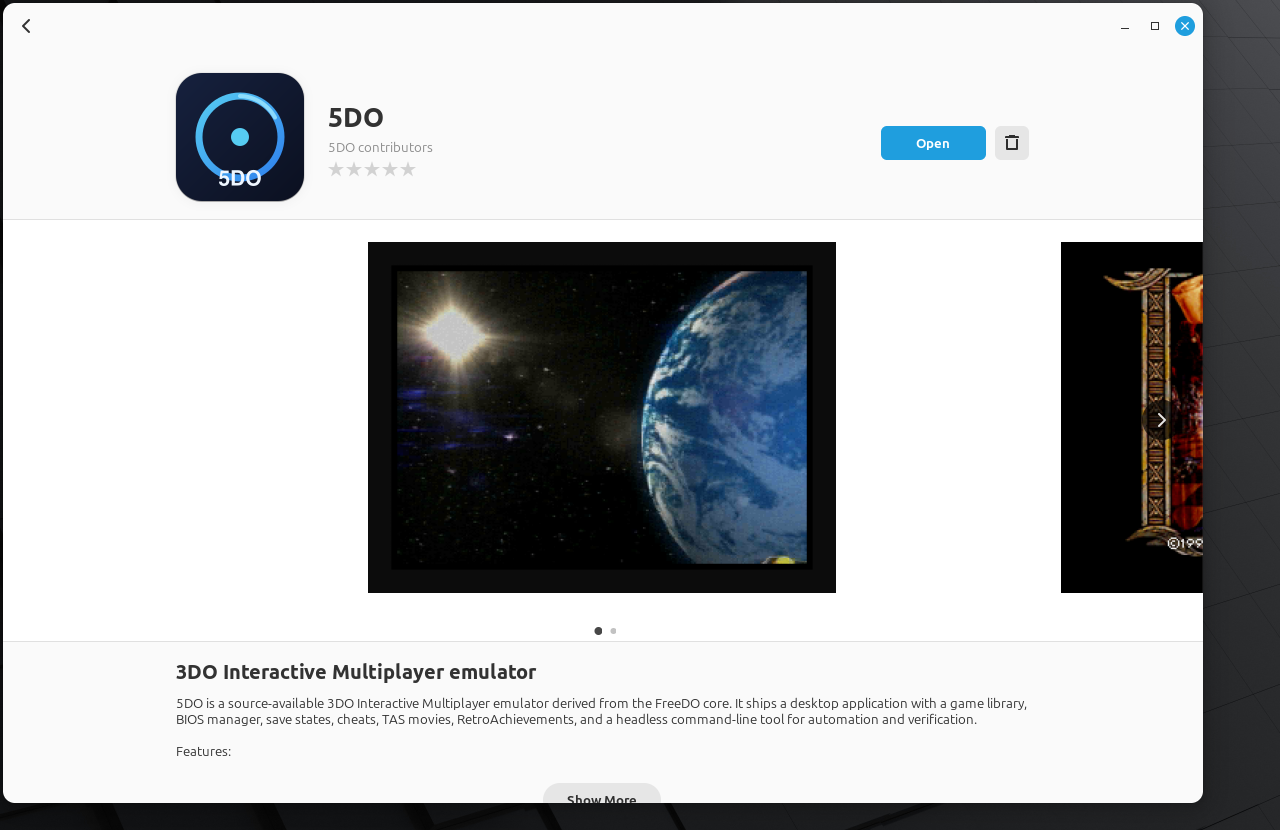
Evidence: TestCorpus.md §1.1cp.
6. Releasing and validating¶
# Local: build, sign, and install-test the Linux set.
bash packaging/linux/build-deb.sh  --bundle artifacts/bundle/linux-x64 --rid linux-x64
bash packaging/linux/build-rpm.sh  --bundle artifacts/bundle/linux-x64 --rid linux-x64
APPIMAGETOOL=/path/to/appimagetool/AppRun bash packaging/linux/build-appimage.sh \
  --bundle artifacts/bundle/linux-x64 --output artifacts/installers --name 5do-<version>-linux-x86_64.AppImage
bash packaging/linux/build-flatpak.sh --bundle artifacts/bundle/linux-x64 --rid linux-x64 \
  --output artifacts/installers --runtime-version 26.08
bash packaging/linux/sign-artifacts.sh --key-id "$KEY" \
  --keyring-out artifacts/signing/5do-archive-keyring.gpg artifacts/installers
bash packaging/linux/build-apt-repo.sh --repo-dir artifacts/mirror/apt \
  --base-url https://mirror.example.org/5do/apt --key-id "$KEY" artifacts/installers
bash packaging/linux/build-rpm-repo.sh --repo-dir artifacts/mirror/rpm \
  --base-url https://mirror.example.org/5do/rpm --key-id "$KEY" --gpgcheck 0 \
  artifacts/installers
sudo apt install ./artifacts/installers/5do_1.13.2_amd64.deb
CI (linux-packages.yml, called by release.yml) already:
- builds AppImage and Flatpak bundles for both architectures;
- validates
5do.desktop, the MIME XML, the AppStream metainfo, and the package contents (dpkg-deb,rpm -qlp); - imports the signing subkey and signs every artifact and the checksum manifest;
- installs the
.debwithapt-get install, checks the generated symlinks, desktop entry, MIME, metainfo, and icon, runs5do --version,5do-cli selftest --json, and5do-cli doctor, then removes the package and verifies the removal; - installs each
.flatpakand runs5do-cli --versionand5do-cli selftest --jsoninside the sandbox; - publishes
5do-linux-installers(packages, signatures, checksums, keyring), whichrelease.ymlattaches to the GitHub release.
Local acceptance on a real Linux host:
# Debian/Ubuntu/Mint
sudo apt install ./5do_<version>_amd64.deb
5do --version && 5do-cli selftest --json
5do --smoke-test --smoke-output /tmp/smoke.txt   # needs a display or xvfb-run

# Fedora
sudo dnf install ./5do-<version>-1.linux.x86_64.rpm
rpm --checksig ./5do-1.13.2-1.linux.x86_64.rpm

# AppImage without FUSE (containers, minimal installs)
./5do-<version>-linux-x86_64.AppImage --appimage-extract-and-run --version

# Flatpak bundle, including the CLI inside the sandbox
flatpak install --user ./5do-<version>-linux-x86_64.flatpak
flatpak run --command=5do-cli io.github.purelogiccode.FiveDO selftest --json
Record the results in TestCorpus.md and Installers.md, per the evidence rule in ImplementationPlan.md.
7. Publishing and announcement channels¶
Ordered by effort-to-reach. The first three are under the project's control and should exist before any outreach.
| # | Channel | Audience | Effort | Gate / action |
|---|---|---|---|---|
| 1 | GitHub Releases | Existing users | Done | Publishes bundles, signed packages, AppImage, keyring, and checksums |
| 2 | Signed .deb/.rpm downloads | Distro users | Done | apt install ./5do_<version>_amd64.deb / dnf install ./5do-<version>-1.x86_64.rpm |
| 3 | AppImage download | No-install users | Done in CI | 5do-<version>-linux-x86_64.AppImage / 5do-<version>-linux-aarch64.AppImage + .zsync |
| 4 | AppImageHub | AppImage browsers | S | Pull request adding a data entry to the AppImage catalog |
| 5 | AUR (5do-bin) | Arch/Manjaro/Endeavour, Steam Deck | S | PKGBUILD (§8.1) |
| 6 | itch.io | Retro/indie players | S | Free project page; upload AppImage, Flatpak, tarball |
| 7 | Flathub | GNOME/KDE software centers, Steam Deck | L | Licence review first (§9); then a Flatpak manifest and a Flathub app submission |
| 8 | Self-hosted Flatpak | KDE/GNOME users | Done in CI | Single-file 5do-<version>-linux-<arch>.flatpak; add flatpak build-update-repo with the 5DO key if a hosted repository is wanted |
| 9 | Snap Store | Ubuntu users | M | snapcraft.yaml with strict confinement, store review |
| 10 | EmuDeck / RetroDeck / EmulationStation | Steam Deck and HTPC users | M | Upstream pull request adding 5DO as a 3DO option |
| 11 | GamingOnLinux, Boiling Steam, Phoronix | Linux gaming readers | S | News submission; Phoronix for Vulkan/Wayland milestones, not routine releases |
| 12 | r/linux_gaming, r/emulation, r/3DO, r/SteamDeck | Core communities | S | One release-day post, no cross-post spam |
| 13 | Hacker News / Lobsters | Developers | S | Only for a genuinely novel technical story |
| 14 | YouTube (ETA Prime, Gardiner Bryant, The Linux Experiment, Brodie Robertson) | Mass Linux audience | S | Send early access to a release plus a short demo clip |
| 15 | Emulation General Wiki, AlternativeTo | Search traffic | S | Add/edit a 5DO page with the platform matrix |
| 16 | Linux distro archives (Debian, Ubuntu, Fedora) | Everyone | XL | Blocked on licence and network-free builds (§9) |
Release announcement template¶
The first paragraph should be the one sentence a reader repeats to a friend:
5DO 1.12.0 is a 3DO emulator for Windows, Linux, and Apple Silicon macOS. Linux ships as a signed Debian package, an RPM, and a portable AppImage you can install straight from the release page. It needs no runtime install, supports OpenGL and Vulkan, and runs the 378-title compatibility set.
Then, in order: what changed, how to install (one command per distro), how to verify the signature, where to report a problem, and one screenshot or short clip. Keep the BIOS requirement explicit — it is the single most common support question.
Cadence¶
- Announce on release day, then once more only if a point release fixes something users reported.
- Keep a
docs/ReleaseNotes-<version>.mdpage for every release; news sites and package maintainers link to it. - Track per-asset download counts with the GitHub API as the only honest metric; there is no telemetry in 5DO and there should not be.
8. Channel details¶
8.1 AUR (Arch, Manjaro, EndeavourOS, Steam Deck)¶
5do-bin is the right first package: it repacks the released tarball, so it stays in sync with the validated build. AUR also requires a 5do-git package only if there is demand; do not start with it. The maintained reference copy, with build and submission steps, is packaging/linux/aur/ in this repository.
# PKGBUILD sketch for 5do-bin. Fill in both checksums from the release.
# The maintained copy is packaging/linux/aur/PKGBUILD.
pkgname=5do-bin
pkgver=1.13.2
pkgrel=1
pkgdesc="3DO Interactive Multiplayer emulator"
arch=('x86_64' 'aarch64')
url="https://github.com/purelogiccode/5DO"
license=('custom:FreeDO')
depends=('glibc' 'gcc-libs' 'zlib' 'libx11' 'libice' 'libsm' 'libxext'
         'libxrandr' 'libxi' 'libxcursor' 'glib2' 'fontconfig' 'freetype2'
         'libglvnd')
optdepends=('mesa: OpenGL rendering' 'python-dbus: display-sleep inhibit')
options=('!strip')

case "$CARCH" in
  x86_64)  _rid=linux-x64 ;;
  aarch64) _rid=linux-arm64 ;;
esac
_asset="5do-$pkgver-$_rid.tar.gz"

source=("$url/releases/download/v$pkgver/$_asset")
noextract=("$_asset")
sha256sums_x86_64=('REPLACE_WITH_X64_SHA256')
sha256sums_aarch64=('REPLACE_WITH_ARM64_SHA256')

package() {
  install -d "$pkgdir/opt/5do"
  bsdtar -x -f "$srcdir/$_asset" -C "$pkgdir/opt/5do"
  rm -f "$pkgdir/opt/5do/5do.desktop"

  install -d "$pkgdir/usr/bin" "$pkgdir/usr/share/applications" \
    "$pkgdir/usr/share/metainfo" "$pkgdir/usr/share/mime/packages" \
    "$pkgdir/usr/share/icons/hicolor/scalable/apps" \
    "$pkgdir/usr/share/icons/hicolor/256x256/apps"
  ln -s /opt/5do/FiveDo "$pkgdir/usr/bin/5do"
  ln -s /opt/5do/FiveDo.Cli "$pkgdir/usr/bin/5do-cli"

  # The bundle ships desktop-integration reference files under packaging/.
  _pkg="$pkgdir/opt/5do/packaging"
  install -m 0644 "$_pkg/5do.desktop" "$pkgdir/usr/share/applications/"
  install -m 0644 "$_pkg/5do.xml" "$pkgdir/usr/share/mime/packages/"
  install -m 0644 "$_pkg/io.github.purelogiccode.FiveDO.metainfo.xml" \
    "$pkgdir/usr/share/metainfo/"
  install -m 0644 "$_pkg/5do.svg" \
    "$pkgdir/usr/share/icons/hicolor/scalable/apps/"
  install -m 0644 "$_pkg/5do-256.png" \
    "$pkgdir/usr/share/icons/hicolor/256x256/apps/5do.png"
  rm -rf "$_pkg"
}
The bundle tarball has no top-level directory, so the PKGBUILD extracts it with noextract + bsdtar rather than letting makepkg unpack it into $srcdir.
!strip is required: the apphost is a self-contained single-file executable and stripping it can corrupt the embedded runtime.
8.2 AppImageHub¶
Open a pull request against the AppImage catalog repository with a data entry pointing at the release asset URL, license, categories, and a screenshot. The catalog is generated from those files, so the entry must name the exact published assets (5do-<version>-linux-x86_64.AppImage, 5do-<version>-linux-aarch64.AppImage) and their update information.
Remember that AppImages need FUSE 2 on Ubuntu 22.04+. Document --appimage-extract-and-run for containers and minimal installs, and consider shipping libfuse2 as an optional dependency in the .deb.
8.3 Flatpak and Flathub¶
A Flatpak is the highest-value Linux channel after AppImage, because it is what GNOME Software, KDE Discover, and the Steam Deck's Discover store show. The single-file 5do-<version>-linux-<arch>.flatpak bundles are built in CI from the published apphosts (packaging/linux/build-flatpak.sh and io.github.purelogiccode.FiveDO.yml), so users can install 5DO from a file today. Two constraints still gate Flathub:
- Flathub's build system has no network access and expects a source build. A .NET app needs the
org.freedesktop.Sdk.Extension.dotnet11SDK extension and adotnet publishstep, or a vendored NuGet cache. The release.flatpakavoids this by packaging the published tree, but that is not how Flathub builds. - The licence must permit redistribution. See §9 before starting.
For a self-hosted repository (flatpak build-export, flatpak build-update-repo --gpg-sign=$KEY, served from any static host you already run), keep the OSTree repository with build-flatpak.sh --repo-dir instead of shipping only the single-file bundle, then submit to Flathub once the licence position is settled.
Expected permissions: --share=network (RetroAchievements, metadata lookup), --socket=pulseaudio, --socket=x11, --socket=wayland, --device=all (gamepads, optical drives), --filesystem=home (BIOS and images), --filesystem=/media and --filesystem=/run/media (disc images on USB drives; removable-media is a flatpak override nickname that the finish-args metadata parser rejects), and --talk-name=org.freedesktop.ScreenSaver (display-sleep inhibit).
8.4 Snap¶
snapcraft.yaml with base: core24, confinement: strict, and plugs home, removable-media, joystick, pulseaudio, opengl, x11, wayland, desktop, network. removable-media and joystick are not auto-connected, so the store listing must tell users to run snap connect 5do:removable-media. The Snap Store allows proprietary apps but reviews them; the non-commercial clause needs the same decision as Flathub.
8.5 Steam Deck and EmuDeck¶
The evdev gamepad path and display-sleep inhibit are validated on real hardware, so the remaining work is packaging and presentation:
- Publish an AppImage with an embedded
--fullscreendesktop action, and document adding it as a non-Steam game. - Add 5DO as an option in EmuDeck/RetroDeck's 3DO emulator list through an upstream pull request. Those tools install Flatpaks/AppImages for the user and put the entry where Deck users look.
- Keep the BIOS requirement in the first-run dialog; Deck users often have no keyboard.
8.6 Press and community¶
- GamingOnLinux covers emulator releases regularly; send a short news item with the release URL, one screenshot, and the "no runtime required" angle.
- Phoronix is worth a note only for a graphics milestone (Vulkan surfaces, Wayland, Mesa performance), not for version bumps.
- Reddit works best as one post in
r/linux_gamingplus one inr/3DO; answer questions for the first 24 hours instead of cross-posting everywhere. - YouTube converts better than any text channel. A 60-second clip that boots a game, changes a filter, and shows the gamepad working is enough.
9. Licence reality check¶
The FreeDO notice reproduced in LICENSE restricts commercial use and requires the FreeDO rights holders' approval for it. The project's own note says 5DO is "non-commercial and source-available only" until that approval exists.
Consequences:
| Destination | Requirement | Position today |
|---|---|---|
| Debian / Ubuntu archives | DFSG: free redistribution, including commercial use | Blocked. The non-commercial clause is a field-of-use restriction |
| Fedora / openSUSE repositories | Fedora licensing: redistributable and commercially usable | Blocked, same reason |
| Flathub | Licence must permit redistribution; non-commercial apps need an explicit decision | Needs review. Ask Flathub before building the manifest |
| Snap Store | Proprietary apps allowed; publisher must have distribution rights | Needs review of the same clause |
| AUR | Must be legally redistributable; no charge is made for the package | Probably fine, but keep the notice and attribution in the package |
| Self-hosted APT/RPM/AppImage | The project distributes its own build | Fine; attribution and the licence text ship in the package |
| itch.io | Free downloads under the project's own terms | Fine |
Two paths clean this up:
- Ask the FreeDO rights holders for written permission or a licence clarification. If they grant commercial-use rights, the Debian/Fedora/Flathub question mostly disappears (network-free builds and vendored NuGet packages remain the technical work).
- Keep the FreeDO-derived core under the current terms and license the 5DO-specific code (frontend, CLI, tooling) separately. That does not help the combined binary, because the core is linked into both apphosts; the archives package the combined binary, so the restriction still applies.
Until one of those happens, treat official distro archives as out of scope and put the effort into signed release downloads, AppImage, AUR, and Steam Deck channels. Record the decision in ReleaseLegalReview.md.
This section is engineering guidance, not legal advice. Get a lawyer's read before submitting to a store that reviews licences.
10. Adoption backlog (Linux)¶
Ordered by impact on "does a Linux user get a working game today". Each item is a candidate for the ImplementationPlan.md backlog; none is committed until it has an ID.
| Priority | Item | Why it matters | Effort |
|---|---|---|---|
| P0 | BIOS auto-discovery | Every new user hits "no BIOS". Scan ~/.local/share/5DO/bios, ~/BIOS, ~/Documents/BIOS, and the folder next to the executable, then offer a one-click "use this BIOS" prompt. Never download ROMs. Implemented: bios discover, the first-run Use this BIOS button, and the doctor BIOS row | S |
| P0 | 5do-cli doctor | A single command that dumps distro, session type, GL/Vulkan renderer, audio device, gamepad permissions (input group, /dev/uinput), XDG paths, and the last 200 log lines. Cuts support round-trips and gives useful bug reports. Implemented: 5do-cli doctor [--json] [--strict] reports session, data-folder access, disk space, native libraries, evdev/optical devices, settings, and BIOS discovery | M |
| P0 | Wayland guidance and fallback check | X11/XWayland works today; Wayland-only sessions fall back to the slower offscreen path. Detect WAYLAND_DISPLAY without DISPLAY, warn once, and document the XWayland workaround. Implemented: 5do-cli doctor reports the case and the shell logs it once and shows a status-line hint | S |
| P1 | AppImage auto-update | Embed zsync info and surface a newer release. Implemented: the AppImage embeds zsync update information and the existing startup/update check offers the release page; remaining work is an in-app download if wanted | M |
| P1 | Steam Deck preset | A Deck-friendly on-screen hint for the BIOS step and documented non-Steam-game setup. Implemented: the desktop entry has a Play in fullscreen action; the BIOS hint and EmuDeck entry stay as REL-10 | S |
| P1 | Self-hosted Flatpak | Discover-store visibility without waiting for Flathub. Implemented: build-flatpak.sh produces 5do-<version>-linux-<arch>.flatpak bundles for x64 and arm64, covered by the GPG signatures; a hosted repository is optional | M |
| P1 | EmuDeck/RetroDeck entry | Where Deck users actually look for emulators | S |
| P1 | Flatpak on Flathub | Largest Linux app store; needs the licence decision and a network-free build | L |
| P1 | Snap | Ubuntu's default store; confinement work | M |
| P2 | Native Wayland surface | Removes the XWayland dependency for the Vulkan child surface and future-proofs for Fedora/KDE defaults | L |
| P2 | Ubuntu PPA / Fedora COPR | Direct apt/dnf installs without hosting a repository; Launchpad and Copr builders are network-free, so this needs vendored NuGet packages | M |
| P2 | Debian/Ubuntu/Fedora archives | Widest reach; blocked on licence and network-free builds | XL |
| P2 | Crash reporter opt-in | Attach the doctor output plus a backtrace to a prefilled issue | M |
Two things that are not worth doing: a curl | bash installer (unverifiable and blocked by most corporate proxies), and an x86-only static build (the self-contained bundle already has no runtime dependency).
11. Evidence checklist for a signed Linux release¶
-
linux-packages.ymlbuilt.deb/.rpmand AppImage/Flatpak bundles for x64 and arm64. - Each
.flatpakinstalls withflatpak install --user ./5do-<version>-linux-<arch>.flatpakandflatpak run --command=5do-cli io.github.purelogiccode.FiveDO selftest --jsonpasses inside the sandbox on a matching host. - The Linux tarball contains
packaging/5do.desktop,5do.xml, the metainfo, and both icons, anddesktop-file-validateaccepts the fullscreen action. -
5do-cli doctor --strictreports no unexpected warnings on the target host, andbios discoverfinds the test BIOS. -
desktop-file-validateandappstreamcli validate --no-netpass (also in CI). -
dpkg-deb -fshows nodotnet-runtimedependency and the expected X11/font deps. -
apt-get updateis not required:sudo apt install ./5do_<version>_amd64.debsucceeds on the target host with the published dependency list, and the optional mirror scripts still produce signedInRelease/Release.gpgwhen a mirror is wanted. -
build-apt-repo.shandbuild-rpm-repo.shpublish5do-archive-keyring.gpgwith the trees,gpg --verifypasses onInReleaseandrepomd.xml.ascwith only that keyring, andapt/dnfinstall5dofrom a served tree (see §5.1). -
gpg --verifypasses forSHA256SUMS-linux.txt.ascand every artifact.asc(including the two portable bundle tarballs);sha256sum -c SHA256SUMS-linux.txtpasses from a clean download. -
sudo apt install ./5do_<version>_amd64.debsucceeds on a stock Debian/Ubuntu host (dependency list resolves) and5do --versionruns; the reverseapt removecleans up/usr/bin/5do. -
sudo dnf install ./5do-<version>-1.x86_64.rpmsucceeds on Fedora. -
rpm --checksigpasses when packages were header-signed. -
sha256sum -c SHA256SUMS.txtpasses for the five bundles. - The key fingerprint is recorded in §4 and in the release notes.
-
Installers.md,TestCorpus.md, andReleaseChecklist.mdrecord the run. - The release page lists every package, both AppImages, both Flatpak bundles, the keyring, and both checksum manifests; no repository or extra infrastructure is required.